KAIST develops chip to predict brain tumor treatment response
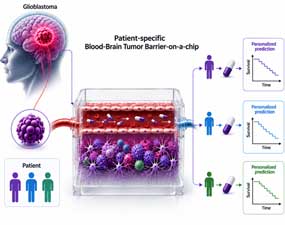 A Korean research team has developed a patient-specific chip that recreates glioblastoma tumor cells and their surrounding blood vessel environment, potentially allowing treatment responses to be predicted more accurately for individual patients.
South Korea’s national research university, KAIST, announced on 18 August that a team led by Professor Song Ih Ahn of its Department of Mechanical Engineering, in collaboration with researchers from Sungkyunkwan University, CHA Bundang Medical Center, and CHA University, developed the blood-brain tumor barrier (BBTB) chip.
Glioblastoma is one of the most aggressive brain tumors and is difficult to treat because its characteristics vary among patients. Treatment is further complicated by the blood-brain barrier, which can limit the amount of anticancer drugs reaching the tumor. The barrier also changes as glioblastoma develops, with the extent of these changes differing between patients. Current treatment-response predictions rely largely on tumor genetics and biomarkers, which do not fully capture differences in the vascular environment surrounding each tumor.
The new microfluidic chip addresses this limitation by combining patient-derived glioblastoma cells with brain vascular endothelial cells and astrocytes to recreate the boundary between tumor and normal brain tissue. Perivascular and immune cells can also be incorporated to more closely reproduce each patient’s tumor environment.
Using tumor cells from three glioblastoma patients, the researchers created patient-specific BBTB chips and tested temozolomide (TMZ) and bevacizumab (BEV), two standard glioblastoma treatments. Although all three patients had the same MGMT promoter methylation result and were therefore expected to respond similarly, the chips showed differences in both vascular barrier characteristics and drug responses. The results closely matched the patients’ actual clinical courses, suggesting that the condition of the vascular barrier can influence treatment response even when patients have similar genetic profiles.
The platform could allow multiple drugs to be tested using a patient’s own tumor cells and surrounding environment, potentially identifying promising treatment options before therapy. It could also serve as a model for screening new drug candidates. Professor Song Ih Ahn said the team plans to validate the platform in a larger patient population and develop it as a preclinical tool for personalized treatment strategies and drug development.
KAIST doctoral student Minsu Ryoo and Sungkyunkwan University doctoral student Gaeun Lee were co-first authors. The study, Human Blood-Brain Tumor Barrier on a Chip to Investigate Personalized Treatment for Glioblastoma Patients, was published in Small on 27 June 2026. The research was supported by the Korea-US Collaborative Research Fund and Korea Health Industry Development Institute, as well as the Early-Career Researcher Program of the Ministry of Science and ICT and the National Research Foundation of Korea.
Category: Technology & Devices