BiDaKidney targets affordable automated peritoneal dialysis
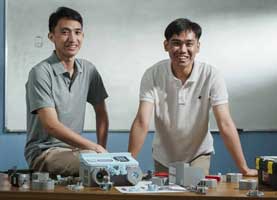 As healthcare costs rise and chronic diseases become more widespread, frugal technology is gaining importance as a way to make essential medical care more accessible. One example is BiDaKidney, developed by University of the Philippines Diliman engineering graduates Andrew Jacob Buensalido and Allyson Cabrestante as a low-cost, semi-automated peritoneal dialysis (PD) machine designed to make automated dialysis more accessible to patients with chronic kidney disease (CKD).
Named after the Filipino word “bida”, meaning hero, BiDaKidney automates the movement of dialysate fluid to and from the patient. It uses peristaltic pumps for contact-free fluid handling, load cells to measure fluid volume, and a simple user interface in a compact 2.5 kg machine. The project is aimed at people with limited access to dialysis options.
Patients enter treatment parameters for their PD fill, dwell and drain cycles through the user interface, then place their PD sets on load cells on either side of the machine to monitor the amount of fluid transferred. The tubing is inserted into peristaltic pumps, which pinch the tubes in sequence to create flow to and from the patient. A dual-tube clamp regulates the flow and is designed to prevent leakage and backflow during treatment. A microcontroller controls pump speed activates the appropriate tube clamp and records the total volume of dialysate transferred and the number of completed cycles.
BiDaKidney received the Dr. Francis Chua Innovation Award after placing first in the Design Category of the 2026 University Project Competition hosted by the UP Diliman College of Engineering. It was also named Best Capstone Project in the UP Department of Mechanical Engineering at a colloquium held June this year.
The machine is intended as an upgrade to manual PD rather than a direct competitor to high-end automated peritoneal dialysis (APD) cyclers. Its design focuses on automating essential functions without specialized cassettes and the additional features and sensors found in commercial machines.
The development team initially used 3D printing to build and test the peristaltic pump at the core of the system. After finding that DC motors could not provide sufficient performance, the team adopted stepper motors and used open-source designs for NEMA 17 motors as starting points for its own components. Once the pump worked with existing PD sets, the team integrated the electronics, upgrading to heavy-duty TB6600 motor drivers after repeated overheating problems and adding an internal DC fan for cooling.
Straight-bar load cells were selected to work with the PD sets, which are suspended from the machine. The team later developed a dual-tube clamp driven by a single motor after finding that pump occlusion alone could not prevent leakage and backflow. This design reduced both the number of motors and the machine’s weight. The final development stage focused on usability, including tool-free pump-cover fasteners and hook-like attachments that make it easier to install tubing in the pump rotors.
Manual PD requires multiple open line exchanges each day, which can increase contamination risks and place physical and mental demands on patients and caregivers. Commercial APD machines can improve convenience and treatment management but typically cost more than US$10,000, putting them out of reach for many patients, particularly in developing countries.
BiDaKidney is designed to provide automated PD at a target cost of around $100, or roughly 1% of the price of commercial cyclers. It uses widely available PD sets rather than specialized cassettes, avoiding the need for proprietary consumables. At 2.5 kg, the machine is also designed for portability, allowing patients to perform PD at home, school or work.
PD nurses and nephrologists at the Philippine Children’s Medical Center have provided positive feedback on BiDaKidney’s fluid automation and volume-monitoring functions. Future development will focus on usability features such as audio cues for the start and end of treatment phases, as well as redesigning the chassis for scalable manufacturing through processes including vacuum casting and injection molding.
Meanwhile, the team is reportedly planning to integrate the electronics into a single printed circuit board to simplify assembly and conduct formal clinical testing and broader patient evaluations to assess safety, performance and user experience.
**********
Source: James Dyson Award (https://www.jamesdysonaward.org/en-PH/2026/project/bidakidney)
Category: Technology & Devices