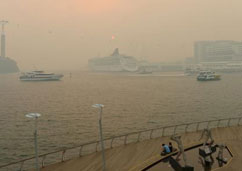
Bad health the cost of China’s rapid growth

When Guo Baochai first joined a cancer support group after being diagnosed with lung cancer in 2005, most of his fellow patients who practised qigong twice a week at Beijing’s Tuanjiehu Park were in their 50s and older.
Now, younger patients are joining the group of about 30 people for morning exercises. A few are only in their 30s, said the 67-year-old retiree.
“There are probably many factors that caused my cancer but my doctor said the environment is possibly one of them,” said the non-smoker, whose cancer is now in remission.
For Guo, the trade-off between economic growth at all costs – which has led to smoggy skies and polluted rivers – and the nation’s deteriorating health is not one he is willing to make.
While his monthly pension has doubled to more than 2,000 yuan (US$328.33) from a decade ago, he has also found himself suffering from more ailments.
It is no wonder that many global health experts share the view that China’s rapid growth over more than three decades and its rise to become the world’s No. 2 economy came at what a global health expert called “an immeasurable, if not irreversible social cost”.
The expert, Dr Huang Yanzhong, a senior fellow for global health at the United States-based Council on foreign relations, told The Straits Times that in the past decade, multiple crises have occurred that are associated with damage to health, the environment and the social fabric.
The sheer size of China’s $9.3 trillion economy and 1.3 billion population has just made the magnitude and seriousness of the problem more apparent.
For instance, rapid industrialisation without proper regulation of chemical waste disposal has polluted more than 70 per cent of China’s lakes and rivers, said Dr Huang.
Indeed, there is a growing consensus on the environment’s harmful effects and their link to the rise of chronic diseases such as cancer, diabetes and heart problems in the country, experts said.
Apart from the environment, another major factor has to do with more Chinese leading a sedentary lifestyle and eating a fatty diet, often associated with rising affluence.
Home to roughly a fifth of the world’s population, China accounts for 27 per cent of global cancer deaths, according to the World Health Organisation.
In 2012, more than half of liver cancer deaths and a third of lung cancer deaths globally were in China, which produces 40 per cent of the world’s cigarettes and where toxic urban smog is causing increasing concern.
About 30 per cent of the world’s diabetes sufferers, who are more prone to cardiovascular disease, stroke and chronic kidney disease, are found in China.
“This is a problem that many developing countries and not just China alone face, as health promotion has not kept up with economic development,” said Professor Chen Chunming from the Beijing-based Health Development Research Centre.
But with 85 per cent of deaths caused by non-communicable chronic diseases (NCD), compared with the global average of 60 per cent, China is facing an NCD “epidemic”, Dr Huang said.
Liu Shuhuang, 63, from Liaoning province, spent six months battling lung cancer and was given a clean bill of health recently.
His wife Wang Chunfeng, 57, told The Straits Times that her husband fell ill just when they were about to retire and enjoy their lives.
“I was very worried and couldn’t sleep for days, but at least things are okay now.”
Some experts said the rising incidence of NCDs is a “public health crisis”, with hefty health-care costs putting the country’s long-term growth at risk.
In a Bloomberg report last September, Paul Zimmet, from the International Diabetes Federation, said the disease in China has become a “catastrophe”.
He said: “The booming economy in China has brought with it a medical problem that could bankrupt the health system.”
Dr Tang Shenglan from the Duke Global Health Institute said these increased risks, coupled with an ageing population, might lead to more health insurance and benefit payouts in the future, which could increase the state’s medical care costs.
Between 2005 and next year, the burden of death and health complications related to NCDs will have cost $500 billion.
Tackling the problem early will pay dividends – surely a good reason for the government to act decisively, experts said.
China has already put in place some measures. In 2009, it overhauled the health-care system, establishing a universal insurance system to give people more access to medical care. Those aged above 65 get free check-ups, and women in rural areas receive free hepatitis B jabs as well as cervical and breast cancer screenings.
To reduce air pollution, Beijing has set limits on burning coal and taken high-polluting vehicles off the roads.
“As with any policy, it takes time to see results so it might not be fair to say that China has not handled these health-care issues well,” Chen said.
Disagreeing, other experts said the government can do much more, such as putting NCD control on the political agenda and investing more in health awareness programmes.
The lack of funding remains a major issue. China’s health spending in 2011 was a mere 2.3 per cent of gross domestic product compared with 9.7 per cent in the US, according to the World Bank.
Implementation and enforcement of policies are patchy, especially in the poor and rural parts of China, Dr Tang said.
Another significant hurdle is the powerful state tobacco monopoly, which brings in about 240 billion yuan in fiscal revenue a year. This has led, some experts said, to the least effective anti-tobacco policies in the world.
For Guo, he knows exactly where the buck stops.
He said: “China is strong economically but in areas like the environment and food safety, we’re weak. It’s a contradiction that the government has a responsibility to address.”
Source: ANN
Published: 24 Feb 2014
Category: Top Story